
Choosing the right dental restoration depends on more than appearance or price. Your dentist will consider the number of missing or damaged teeth, the condition of your gums and jawbone, the strength of the remaining teeth, the restoration material, and your long-term needs.
In this guide, we explain the main types of dental restorations and prices, including removable and fixed options, common materials, their advantages and limitations, and the factors that influence the final cost.
Types of Dental Restorations
Dental restorations can generally be divided into two main categories: removable and fixed dental restorations. The appropriate option depends on the condition of your teeth and gums, the number of missing teeth, your bite, and whether the restoration will be supported by natural teeth or dental implants.
1. Removable Dental Restorations
Removable dental restorations are designed to be taken out and put back in by the patient. They are commonly used when several teeth are missing or when a complete denture is needed.
Some of their main advantages include:
- They generally involve simpler procedures than implant-supported treatments.
- They are often more affordable than fixed or implant-supported restorations.
- They can provide a natural appearance when the tooth shape and shade are selected appropriately.
- They may require fewer dental appointments than more complex restorative treatments.
- They can be removed for cleaning, making daily maintenance relatively straightforward.
However, removable restorations also have some limitations. They may feel less stable than fixed restorations, particularly while chewing or speaking. Some patients also need time to become accustomed to wearing them.
Patients with significant gum disease, bone loss, or other oral health problems may need preliminary treatment before receiving a removable restoration.
The most common removable options include partial dentures, which replace some missing teeth, and complete dentures, which replace all teeth in one dental arch. Using an oral irrigator can also help maintain oral hygiene and clean around the gums and remaining teeth.
2. Fixed Dental Restorations
Fixed dental restorations are attached inside the mouth and are not intended to be removed by the patient. They are commonly used to restore damaged teeth or replace missing teeth.
Depending on the clinical situation, fixed restorations may include crowns, bridges, and implant-supported restorations.
One of the main advantages of fixed restorations is their stability. They can provide a natural appearance and allow patients to chew and speak comfortably when properly designed and fitted.
However, some fixed restorations require preparation of the supporting teeth. For example, traditional dental bridges may require the neighboring teeth to be reshaped so they can support the restoration.
The amount of tooth preparation varies according to the type of restoration, the condition of the supporting teeth, and the treatment plan.
Main Types of Dental Restorations and Prices
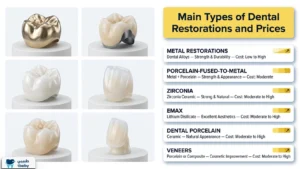
The cost of dental restorations can vary significantly from one patient and clinic to another. Material, laboratory quality, dentist experience, geographic location, the number of teeth being treated, and additional procedures can all affect the final price.
For this reason, the following information should be considered a general guide rather than a universal price list.
| Type of Restoration | Common Material | Main Advantage | Typical Cost Level |
| Metal restorations | Dental alloys or precious metals | Strength and durability | Low to high |
| Porcelain-fused-to-metal | Metal core + porcelain | Balance between strength and appearance | Moderate |
| Zirconia | Zirconia ceramic | Strength and natural appearance | Moderate to high |
| EMAX | Lithium disilicate ceramic | Excellent aesthetics | Moderate to high |
| Dental porcelain | Ceramic | Natural appearance | Moderate to high |
| Veneers | Porcelain or composite | Cosmetic improvement | Moderate to high |
Choosing the Best Dental Restoration for Your Needs
Choosing the right dental restoration depends on more than price. Your dentist will consider your oral condition, functional needs, aesthetic goals, and long-term oral health.
1. Metal Dental Restorations
Metal restorations are known for their strength and durability, making them suitable for areas exposed to strong chewing forces. However, their metallic appearance may be less suitable for visible teeth.
2. Porcelain-Fused-to-Metal Restorations
These restorations combine a metal base with a porcelain layer, offering a balance between strength, appearance, and cost.
However, the porcelain may chip over time, and the metal margin can sometimes become visible if the gums recede.
3. Metal-Free Dental Restorations
Metal-free options provide a more natural appearance and include:
- Zirconia: Strong and durable.
- EMAX: Offers excellent aesthetics and translucency.
- Porcelain: Provides a natural-looking appearance.
The best material depends on the tooth location, bite, aesthetic needs, and overall dental condition.
4. Dental Veneers
Veneers are thin shells placed on the front of teeth to improve color, shape, and minor imperfections.
Unlike crowns, veneers mainly cover the front surface of the tooth. Their cost depends on the material, number of teeth, and treatment complexity.
For maintaining healthy teeth and gums, regular use of dental floss is also an important part of your daily oral hygiene routine.
What Determines the Price of Dental Restorations?
Dental restoration prices vary depending on the patient, treatment, and clinic. The main factors include:
- Material: Zirconia, EMAX, porcelain, and metal have different costs.
- Number of teeth: More teeth generally mean a higher cost.
- Dental and gum condition: Additional treatments may be needed before restoration.
- Additional procedures: Root canals, extractions, or gum treatments can increase the total cost.
- Dentist and laboratory: Experience, laboratory quality, and technology can affect the price.
- Location: Prices vary between countries, cities, and clinics.
- Number of appointments: Complex treatments may require several visits.
Dental Restoration Prices: What Should You Expect?
When researching types of dental restorations and prices, it is important to avoid relying on a single advertised price.
A clinic may advertise the price of a crown, for example, while the final treatment cost may also include examination, X-rays, tooth preparation, temporary restorations, laboratory fees, or other procedures.
In many markets, basic removable restorations are generally less expensive than fixed or implant-supported solutions. Among fixed restorations, the price often increases when patients choose advanced ceramic materials or more complex treatment plans.
High-quality zirconia and EMAX restorations may cost several hundred US dollars per tooth in many markets, while premium clinics and complex cases can be significantly more expensive.
Because prices change between locations and clinics, patients should request a complete treatment estimate before beginning treatment.
How to Choose the Right Dental Restoration
The most expensive restoration is not always the best. The right choice should balance:
- Function and appearance
- Durability
- Oral health
- Dentist’s recommendation
- Maintenance and budget
For example, back teeth usually need strong, durable restorations, while front teeth often require greater attention to aesthetics.
Before choosing, ask your dentist about the recommended material, total cost, expected lifespan, maintenance, and any additional treatments needed.
Dental Restorations and Prices: Quick Comparison
The following table provides a general comparison of common dental restorations, their typical cost levels, and the situations in which they are most commonly used:
| Restoration | Typical Cost Level | Common Use |
| Removable dentures | Lower | Replacing several or all missing teeth |
| Porcelain-fused-to-metal | Moderate | Crowns and bridges |
| Zirconia | Moderate to high | Strong, aesthetic crowns and restorations |
| EMAX / lithium disilicate | Moderate to high | Highly aesthetic restorations |
| Porcelain restorations | Moderate to high | Natural-looking restorations |
| Veneers | Moderate to high | Cosmetic improvement |
These cost levels are only general comparisons. Actual dental restorations and prices depend on the treatment plan and the local dental market.
How Long Do Dental Restorations Last?
The lifespan of a dental restoration depends on several factors, including the material, oral hygiene, bite forces, quality of fabrication, and the health of the supporting teeth and gums.
Regular dental examinations and good oral hygiene can help extend the lifespan of many restorations.
Patients who grind or clench their teeth may also require additional protection, such as night mouth guards, depending on their dentist’s recommendation.
Final Thoughts on Dental Restorations
Choosing the right dental restoration depends on your oral health, treatment needs, desired appearance, and budget. Understanding the different types of dental restorations and prices can help you compare your options and make a more informed decision.
Before starting treatment, consult your dentist to determine the most suitable restoration and get an accurate estimate of the total cost.
Frequently Asked Questions About Dental Restorations
What are the main types of dental restorations?
The main options include removable dentures, crowns, bridges, implant-supported restorations, veneers, and restorations made from ceramic or metal materials.
Which dental restoration is the most durable?
Durability depends on the material, tooth location, bite forces, oral hygiene, and quality of treatment. There is no single restoration that is best for every patient.
Are zirconia restorations better than porcelain-fused-to-metal?
Not necessarily. Zirconia can provide excellent strength and aesthetics, while porcelain-fused-to-metal remains a useful option in many clinical situations.
How much do dental restorations cost?
The cost varies according to the material, number of teeth, dentist, laboratory, location, and additional treatments required.
Are removable dentures a good option?
Yes. They can be a practical solution for replacing several or all missing teeth, especially when fixed or implant-supported treatment is not suitable.
Do fixed restorations require tooth preparation?
Some fixed restorations require preparation of the supporting teeth. The amount of preparation depends on the type of restoration and the clinical condition of the teeth.
Are veneers the same as crowns?
No. Veneers mainly cover the front surface of a tooth, while crowns cover most or all of the visible tooth structure.
How long do dental restorations last?
Their lifespan varies depending on the material, oral hygiene, bite, supporting teeth, and maintenance. Proper care can help extend their service life.
Does dental insurance cover dental restorations?
Coverage depends on the insurance plan, the reason for treatment, and the specific type of restoration.
How can I choose the right dental restoration?
Your dentist should evaluate your teeth, gums, bite, aesthetic goals, oral health, and budget before recommending the most appropriate option.
https://www.nhs.uk/live-well/healthy-teeth-and-gums/dental-treatments/