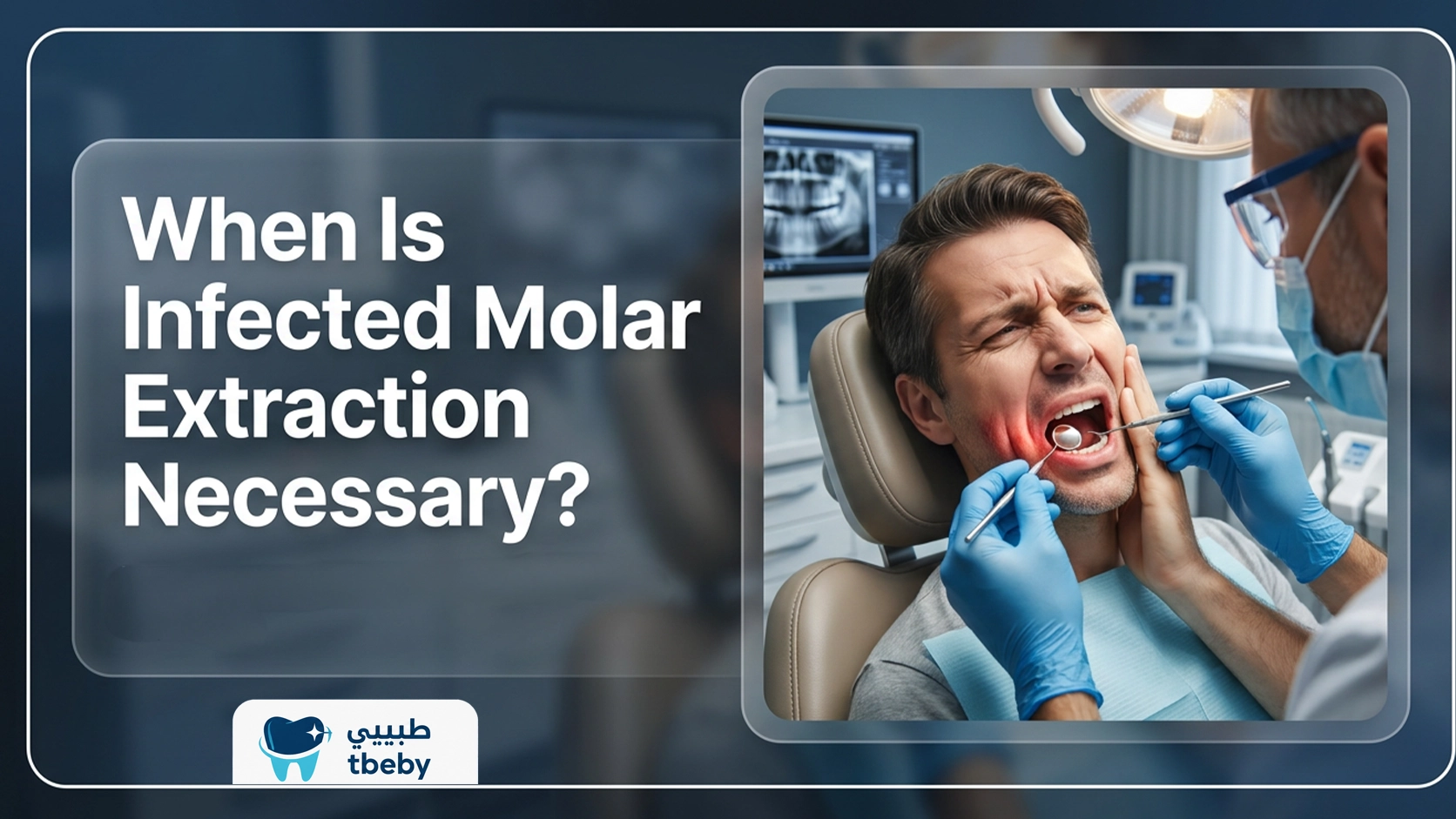

Infected molar extraction becomes necessary when a severe gum infection or untreatable tooth decay threatens the surrounding teeth and overall oral health. Many people experience intense molar pain caused by infection or severe gum inflammation that requires urgent treatment.
This raises an important question: must an infected molar always be extracted, or are there alternative treatments a dentist can try first? In this article, we explain how dentists treat molar infections, when infected molar extraction is truly required, and what the correct treatment approach looks like.
When Is Infected Molar Extraction Necessary?
The treatment a dentist selects for an infected tooth depends largely on how advanced the damage has become. In some cases, the dentist can avoid extraction entirely; in others, removing the molar is the only viable option.
- When the infection is mild and has not caused major damage, the dentist can thoroughly clean the tooth and eliminate the underlying cause, whether that is decay or a dental abscess.
- Temporary or permanent fillings, or root canal treatment, can then be applied depending on the molar’s condition.
- However, when the infection is severe or the inflammation has caused extensive, irreparable damage, extraction becomes the only remaining solution.
In such advanced cases, extracting the molar removes the source of infection completely, cleans the extraction site, and protects the gum tissue and remaining teeth.
If the infected molar in question is a wisdom tooth, it is never filled, it is always removed entirely. Removing wisdom teeth poses no risk to the patient and has no negative effect on neighboring teeth.
Using sterile medical gauze after the procedure helps control bleeding and protects against further infection.
You can use Medical Gauze to control bleeding and protect the extraction site after the procedure.
Extraction of a Root-Canal-Treated Molar
Sometimes inflammation or complications recur in a molar that has already undergone root canal treatment, with pus or an abscess forming beneath it again, even after prior cleaning. This can result from poor oral hygiene, heavy smoking, or excessive sugar consumption without proper cleaning afterward.
In such cases, the dentist typically needs to:
- Remove the existing root canal filling
- Clean the tooth thoroughly again
- Eliminate the pus buildup
- Refill the molar, often followed by a crown or post to support the tooth and prevent fracturing
However, if inflammation or infection develops again in a previously root-canal-treated molar, the dentist will usually have no choice but to move forward with infected molar extraction, since the tooth typically cannot withstand another round of drilling and filling and becomes increasingly fragile.
In this situation, the dentist administers local anesthesia before extracting the molar completely, sometimes even before removing the accumulated pus or dead tissue.
For fast, effective relief from tooth pain, alternating cold and warm compresses can help in the meantime.
Extracting an Infected Molar at Home: Why It Should Be Avoided
We always advise against attempting to remove an infected molar at home, or extracting any tooth without professional care, to avoid fracturing the molar, spreading infection, or worsening inflammation. Instead, patients should visit a dentist for safe removal, or to explore alternative treatments that may avoid extraction altogether.
Because of the intense pain an infected molar can cause, some people attempt to pull it out themselves, tying a string around the tooth, attaching the other end to a door, and slamming the door shut to remove it.
Others try eating hard foods to loosen the molar, or wiggle it with their fingers and pull it out once it feels less firmly attached to the gum.
All of these methods are entirely incorrect and cause significant additional pain, especially with active infection present, and they can allow the infection to spread throughout the mouth and to neighboring teeth. For this reason, self-extraction of an infected molar is never an appropriate option.
You can use Gum Repair Foam to soothe irritated gum tissue while you wait to see your dentist.
Extraction of a Decayed (Rotten) Molar
In some cases, a molar’s condition deteriorates into severe decay, a stage caused by prolonged neglect of dental hygiene, failure to regularly remove food debris, and ignoring early symptoms of tooth pain.
As decay progresses, the molar reaches its final stage of deterioration, producing a strong, unpleasant odor that spreads throughout the mouth, along with intense pain that interferes with eating and daily activities.
At this stage, patients also notice significant loss of tooth structure, along with darkening of the molar to a black color as a result of advanced decay.
In this situation, the first and only viable option is infected molar extraction, since cleaning and filling cannot repair damage this extensive; there is no remaining solution other than complete removal of the tooth.
Leaving the tooth in place can lead to serious complications, including:
- Spread of decay to neighboring teeth
- Severe inflammation throughout the dental arch
- Pus accumulation beneath the teeth, deteriorating overall oral health
After extraction, patients should take all prescribed medications to eliminate infection, and maintain consistent oral hygiene going forward to prevent the problem from recurring in other molars. Using an antiseptic mouthwash afterward helps sterilize the mouth, protect against infection and gum inflammation, and support long-term oral health.
Aftercare Following Infected Molar Extraction
There are several important recommendations to follow once the procedure is complete:
1. Take Prescribed Medications
Dentists often prescribe antibiotics to fully eliminate infection, sometimes even before the procedure, to kill infection-causing bacteria or address an existing abscess. Pain relievers and anti-inflammatory medications may also help manage post-extraction discomfort.
2. Watch What You Eat
In the first hours after the procedure, avoid hard foods and stick to liquids and soft, easy-to-swallow foods, gradually reintroducing solid foods over the following days. Avoid hot or cold beverages, as they can increase pain, and limit sugary or starchy foods, which raise oral acidity and encourage bacterial activity.
3. Maintain Dental Hygiene
Brush your teeth twice daily, use dental floss, and rinse with antiseptic mouthwash once a day to remove trapped food debris and prevent further infection.
4. Saltwater Rinse Starting
one full day after the procedure, rinsing with a saltwater solution helps eliminate harmful bacteria, reduce pain, stop bleeding, and support gum healing.
5. Cold Compresses
Applying a cold compress to the outside of the cheek near the extraction site helps reduce swelling and inflammation.
6. Natural Remedies
Before and after the procedure, natural remedies such as clove oil or oregano oil drops can help reduce inflammation when applied to the swollen area and rinsed out, repeated several times a day.
You can use Toothpaste for Sensitive Gums to ease discomfort and support gum healing during daily brushing.
A Medical Decision to Protect Your Smile and Long-Term Health
Ultimately, removing an infected molar is not always the first choice, but rather a last-resort procedure dentists turn to once damage exceeds the tooth’s ability to recover, whether due to deep decay, repeated root canal failure, or the tooth being a wisdom tooth.
Consistent oral hygiene, along with following your dentist’s post-procedure instructions regarding medication, cold compresses, and dietary adjustments, is the key to fast gum healing and preventing the problem from recurring, ultimately preserving the health and strength of your remaining teeth.
FAQs About Infected Molar Extraction
Does an infected molar always need to be extracted?
Does inflammation automatically mean the affected tooth must be removed right away?
Not always; if the damage is minor, the dentist may simply clean the decay and fill the tooth to save it.
Is a wisdom tooth treated differently when infected?
What does the dentist do if the infected molar is a wisdom tooth?
Yes, an infected wisdom tooth is extracted immediately without filling, since removing it does not harm neighboring teeth.
When must a previously root-canal-treated molar be extracted?
Why would a dentist ultimately remove a tooth that already had a root canal?
It is extracted if infection recurs with an abscess beneath it, leaving the tooth too fragile for further drilling and filling.
Can I extract my own infected molar at home to relieve pain?
What are the risks of trying to remove an infected tooth yourself at home?
It should never be attempted, as it risks breaking the tooth, spreading infection, and dramatically increasing pain.
What is the only medical option for a rotten molar?
Can a molar that has reached the decay stage still be cleaned and treated?
The only option is immediate, complete extraction to prevent decay and infection from spreading to nearby teeth.
How can I reduce facial pain and swelling after an extraction?
What is the fastest way to relieve pain after having a tooth removed?
Apply a cold compress to the outside of the cheek and take the pain relievers your dentist prescribed.
What should I eat and drink right after having a molar removed?
Which foods are allowed or forbidden in the first hours after extraction?
Stick to cold liquids and soft foods only, avoiding hard foods and hot drinks that can worsen pain.
Why does the dentist prescribe antibiotics after an extraction?
Why is taking prescribed medication important after removing an infected tooth?
Antibiotics eliminate the bacteria causing infection and help prevent an abscess or further spread.
When can I start rinsing with saltwater after the procedure?
What is the correct time to begin using a salt solution after extraction?
Begin saltwater rinses after a full 24 hours to speed up gum healing.
Are there natural oils that help ease tooth infection pain?
Which natural remedies reduce swelling and pain in an infected molar?
Yes, clove oil or oregano oil applied topically are effective natural options for easing swelling and pain.
https://www.nhs.uk/tests-and-treatments/wisdom-tooth-removal/